Maria Jose Guerrero
In a market where 81.3% of consumers research online before buying, according to EMARKETER, knowing your competitors' prices is no longer an option—it's a necessity. However, many retailers and brands fall into the trap of confusing two fundamental concepts: Price Monitoring and Price Intelligence. Believing they are interchangeable is the first step toward a reactive and unprofitable pricing strategy. The real power isn't just knowing what your rival sells for, but transforming that data into a strategic decision that protects your margins and positions you as a leader. This article breaks down how monitoring (the what) feeds intelligence (the why and what to do next) to take your business to the next level.
Table of Contents
- What is Price Monitoring? (The "What")
- What is Price Intelligence? (The "Why" and "What to Do Now")
- The Key Synergy: How Price Monitoring Feeds Price Intelligence
- Strategic Applications by Customer Type
- Practical Use Case: A Sports Retailer Optimizes Its Strategy
- How to Choose the Right Price Intelligence and Monitoring Tool
- Frequently Asked Questions (FAQs) about Price Intelligence and Price Monitoring
- From Manual Reaction to Intelligent Pricing Strategy
What is Price Monitoring? (The "What")
Price Monitoring is the technological process of tracking and recording the prices of specific products across your competitors' sales channels. Its function is clear and direct: to systematically and automatically collect public pricing data from your competitors. But its scope goes beyond a simple number.
Definition and key objectives of Price Monitoring for your business
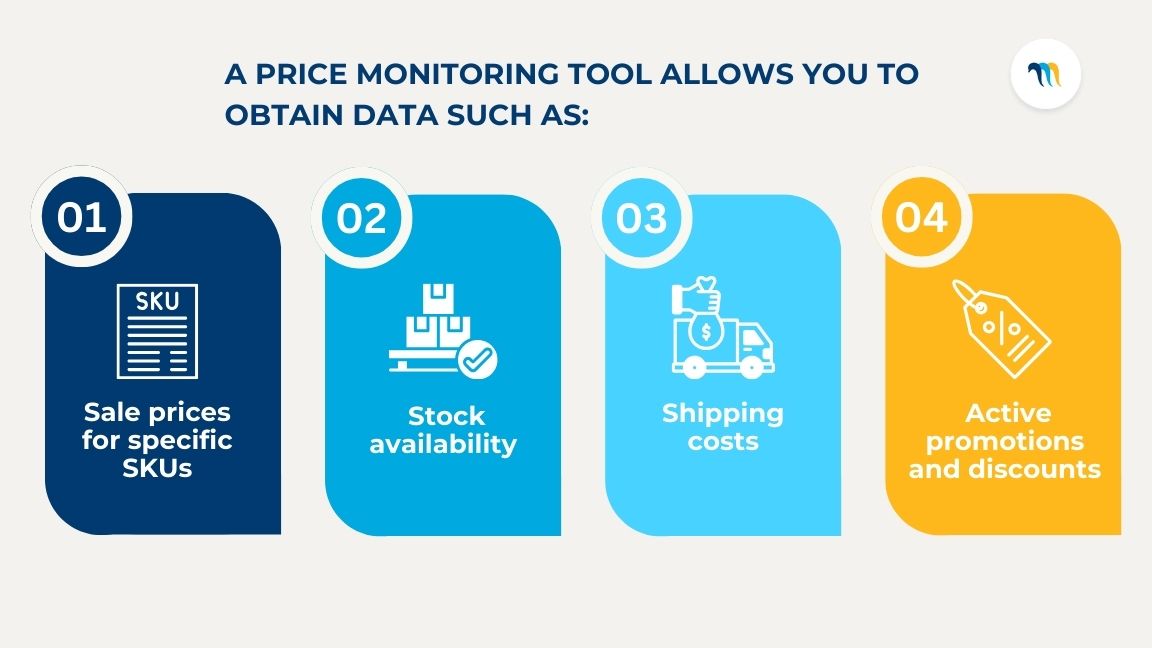
Price Monitoring is the foundation upon which any informed pricing strategy is built. Its goal is not just to know the price, but to get a complete snapshot of the market that includes:
- Automated price data collection: Eliminates the manual, error-prone task of checking websites one by one, providing reliable and up-to-date data.
- Competitor stock tracking: Allows you to identify opportunities when a competitor has a stockout on a key product.
- Identification of catalog changes: Detects when competitors add or remove products, giving you visibility into their strategic moves.
In essence, Price Monitoring gives you the raw data—the raw material. For retailers, it centers on monitoring competitors, while for brands, it focuses on the MAP monitoring of their distributors to ensure compliance with pricing policies.
Essential types of price monitoring
A robust monitoring strategy must cover all the fronts where your customers and competitors are found:
- Direct e-commerce website monitoring: Tracking prices directly on the online stores of your direct competitors, whether they are other retailers or direct-to-consumer brands. The challenge here is the anti-bot systems that block data scraping. That's why at Minderest, we integrate artificial intelligence and advanced algorithms, ensuring accurate and always-available information for your pricing strategy.
Marketplace monitoring: On platforms like Amazon, prices are extremely volatile, changing several times a day. This dynamic turns marketplaces into digital battlegrounds where constant surveillance is indispensable.
The heart of this competition is the Buy Box, the prime real estate on an Amazon product page where the vast majority of sales are concentrated. Winning the Buy Box doesn't just depend on the lowest price, but on a combination of crucial factors like the total price (product + shipping), stock availability, seller performance (ratings, delivery times), and the type of fulfillment (FBA or FBM).
The complexity increases with the presence of multiple sellers. Hundreds of sellers can offer the same product, each with their own pricing strategy and conditions. Therefore, it's vital to monitor not only your own price but also those of the hundreds of sellers competing for the Buy Box.
- Monitoring on Price Comparison Sites (PSMs): Platforms like Google Shopping and Idealo are decisive showcases in the purchasing process. Being present with a competitive price on these channels is essential for capturing qualified traffic and ensuring your products' visibility against the competition. Constant monitoring on PSMs allows you to adjust strategies quickly and optimize your offer to attract the most informed shoppers.
What is Price Intelligence? (The "Why" and "What to Do Now")
Price Intelligence is the set of processes and technologies that analyze the massive datasets collected by Price Monitoring to generate actionable insights. This is where data turns into strategy, profitability, and competitive advantage.
From data to action: the value of strategic Price Intelligence
If Price Monitoring is the what, Price Intelligence is the why and, more importantly, what to do now. It's not about looking at a list of prices, but about understanding the stories that data tells:
- Converting raw data into business insights: Transforms thousands of data points into clear conclusions, such as "We are 5% more expensive in the X category" or "Competitor Y always drops prices on weekends."
- Detecting patterns and market opportunities: Identifies trends, like a new competitor's pricing strategy or the market's response to a large-scale promotion.
What is the difference between Price Monitoring and Price Intelligence?
Price Monitoring is the process of automatically collecting competitor price and stock data (the "what"). Price Intelligence, on the other hand, is the analysis of that data to extract insights, detect patterns, and define business rules that enable strategic and automated decision-making (the "why" and "what to do now").
Key components of a Price Intelligence strategy
A well-executed price intelligence strategy allows companies to take control of their positioning and profitability through several components:
- Price positioning analysis: Uses a price index to visually understand, segmented by category, brand, or product, how customers will perceive you against the competition.
- Optimization of promotions and campaigns: Measures the impact of your offers and those of your rivals to adjust future campaigns and maximize ROI.
- Identification of demand elasticity: Helps predict how sales will react to a price change for a specific product.
- Protection of brand image and margins: Ensures that prices are not only competitive but also profitable and consistent with your brand's perceived value.
The Key Synergy: How Price Monitoring Feeds Price Intelligence
Neither concept can offer its full value alone. Their true power is unleashed when they work in a continuous, automated cycle.
- Monitoring as a data source: It provides the fuel (massive, reliable, and updated data) that the intelligence engine needs.
- Intelligence as a decision engine: It uses that fuel to apply business rules, generate alerts, and automate price changes that respond to market conditions in real time.
This virtuous cycle is the core of an advanced platform. The flow is simple yet powerful: data collected by monitoring is analyzed by the intelligence module, which in turn executes actions (like a price change) or generates reports for decision-making. The impact of that action is measured again, restarting the optimization cycle.
Discover how our platform unifies Price Monitoring and Price Intelligence into a single solution.
Strategic Applications by Customer Type
The application of this synergy varies depending on the business goals of retailers and brands, but the result is always greater control and better responsiveness.
For Retailers: Price Optimization and Competitiveness
For a retailer, the goal is to maximize sales and margin across an extensive catalog. Imagine an electronics retailer during Black Friday. Their main competitor launches a flash sale on a popular TV. Without automated monitoring, it could take them hours to notice, losing crucial sales. With an integrated system, they not only receive an instant alert, but a predefined business rule can automatically adjust their own price to remain competitive, while always protecting the established minimum margin.
For Brands and Manufacturers: MSRP Control and MAP Monitoring
For a brand, the priority is to protect the value of its products throughout the distribution channel. Think of a high-end cosmetics brand that sells through 50 online distributors. Manually checking that everyone respects the suggested retail price is a colossal task. A MAP monitoring platform automates this surveillance, sending immediate alerts when a distributor violates the pricing policy. This allows the brand to act quickly to protect the perceived value of its products and maintain a fair relationship with its entire channel.
Practical Use Case: A Sports Retailer Optimizes Its Strategy
A large sporting goods retailer faces a constant challenge: with a catalog of thousands of SKUs, it's impossible to manually adjust prices to compete with the agility of online-only players. The pricing team spends more time collecting data than analyzing it.
The solution with Minderest: automated monitoring and pricing
A solution is implemented to daily monitor the prices and stock of their entire catalog across their five main online competitors. At the same time, pricing rules are configured on the platform to automate the response to market movements.
Price intelligence in action
The tool doesn't just show competitor prices. The Price Intelligence module generates a price index by category, alerting them that while their overall positioning is good, they are 7% more expensive than their closest rival in the "running shoes" category. Additionally, the system identifies 50 top-selling products where competitors are experiencing stockouts.
The strategic result
Based on these insights, the system automatically applies business rules: it adjusts the prices of running shoes to match the most aggressive competitor (while respecting a minimum margin) and slightly raises the price on products where the competition is out of stock, maximizing profit. The pricing team goes from "putting out fires" to overseeing strategy, dedicating their time to analyzing trends and defining more sophisticated rules.
Discover how Decathlon, the sporting goods retail giant, leads the European market by coordinating the prices of thousands of products in real time and guaranteeing competitiveness in every sales channel without manual errors. Read the full case study here.
How to Choose the Right Price Intelligence and Monitoring Tool
Selecting the right technology partner is as important as the strategy itself. When evaluating price intelligence software, consider the following factors:
- Data reliability and quality: The accuracy of the data is the foundation of any decision. Make sure the tool has a robust product matching system.
- Analytical and reporting capabilities: The platform should offer intuitive dashboards and customizable reports so that leadership teams can make informed decisions.
- Scalability: The software must be able to manage catalogs with millions of products and monitor hundreds of competitors without losing performance.
- Integrations: Look for a solution that can easily integrate with your existing systems, such as ERPs or Business Intelligence tools.
- Specialized support: A Customer Success team that understands your business is crucial to getting the most out of the tool.
For a deeper guide, you can check out our tips on how to choose pricing software and the keys to selecting price monitoring tools.
Frequently Asked Questions (FAQs) about Price Intelligence and Price Monitoring
How often should I monitor my competitors' prices?
The frequency depends on the dynamism of your industry. For highly competitive categories like consumer electronics, monitoring several times a day may be necessary. For other sectors, daily tracking is usually sufficient to detect trends and react in time.
Can I use a tool to monitor prices on Amazon?
Yes, and it's essential to do so. Specialized tools not only track the Buy Box price but also the prices of all the sellers competing for it, as well as their stock levels and shipping costs, offering a complete view of the marketplace.
Is Price Intelligence only for large companies with huge catalogs?
No. Although it is indispensable for large retailers, any company that competes on price can benefit. An SME can use price intelligence to find market niches, optimize the price of its star products, or protect its brand from unauthorized distributors.
From Manual Reaction to Intelligent Pricing Strategy
Shifting from viewing Price Monitoring as an end in itself to understanding it as the starting point for Price Intelligence is the mindset change that defines modern retail leaders. It’s not about reacting to the lowest price, but about understanding the market context to act with purpose—protecting margins, strengthening brand image, and ultimately, winning the long game. The combination of robust monitoring with actionable price intelligence is the key to transforming a fragmented workflow into strategic, centralized control.
Ready to turn pricing data into your biggest competitive advantage? Request a demo.
Find out how Minderest can take your business to the next level.
Contact our pricing experts to see the platform in action.
Related Articles

The Algorithm is Ruthless: Why Price Inconsistency Dooms You to Invisibility in AI Search Engines
The digital retail ecosystem is undergoing a structural transition. The advent of Generative Engine Optimization (GEO) and new conversational models has transformed how consumers discover products....
The Rise of Agentic Commerce: Pricing Strategies for New AI Agents
The retail landscape is undergoing a radical metamorphosis: the end shopper is no longer always a human behind a screen, but an advanced algorithm executing purchasing decisions. The advent of...