Maria Jose Guerrero
How much do prices actually drop on Black Friday?
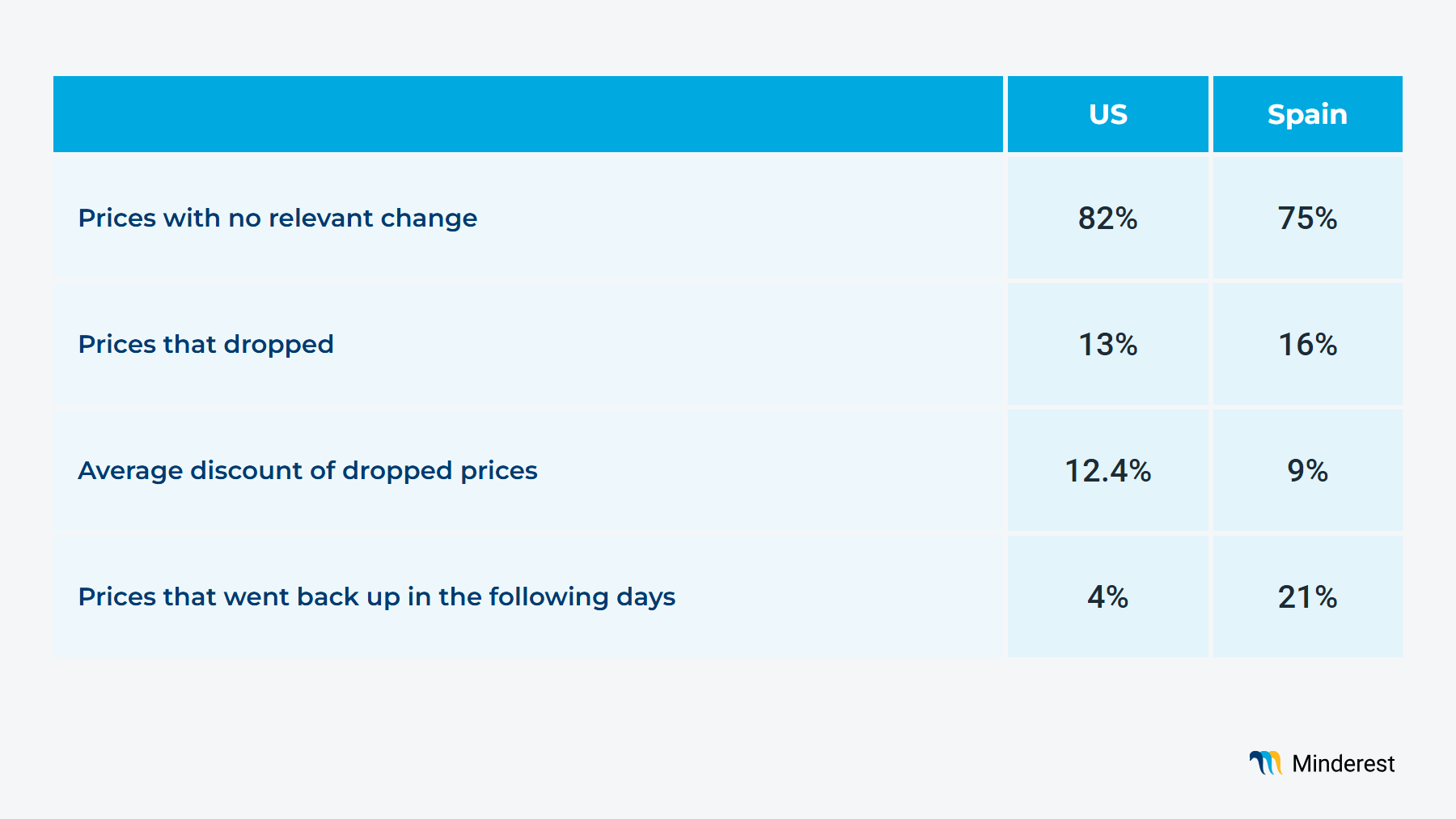
A lot less than the campaigns suggest. Minderest's Black Friday 2025 study tracked consumer electronics prices in the US and Spain, comparing the price on Black Friday itself (November 28, 2025) with the previous week:
| US | Spain | |
| Prices with no relevant change | 82% | 75% |
| Prices that dropped | 13% | 16% |
| Average discount of dropped prices | 12.4% | 9% |
| Prices that went back up in the following days | 4% | 21% |
Methodology: 320 products on Amazon, Walmart, and Target (from November 14 to December 2, 2025) and 486 electronics products across five major Spanish websites and their marketplaces (from November 21 to December 3, 2025). A relevant change was defined as a variation of more than 2% and at least $3 in the US or €3 in Spain.
The conclusion is clear: genuine discounts are concentrated in a small fraction of the catalog, and in Spain they don't last long. Distinguishing real deals from marketing noise is what allows you to respond only where it matters.
Why monitor competitor prices on Black Friday?
Monitoring the competition allows you to use data to decide which products to discount, by how much, and when, rather than reacting blindly. In a market saturated with offers, price intelligence helps you:
- Identify real opportunities: detect which competitors are offering genuine discounts and in which categories, so you can position your value proposition where it performs best.
- Avoid destructive price wars: understand your competitors' limits and set rules to protect your margins, competing on value and not just on price.
- Understand their strategy: analyze whether your rivals are relying on loss leaders, volume discounts, or category-specific promotions, and anticipate their next moves.
What pricing mistakes should you avoid before Black Friday?
The most serious mistake is inflating prices before the event to advertise a bigger discount. The strategy for one of the key Peak Season events begins weeks in advance, and poor planning can damage customer trust for the long term.
What you should never do with your prices
Raising prices weeks before only to apply a fictitious discount isn't just unethical: consumers and price-tracking tools easily detect it, and the damage falls directly on your Price Image, the customer's perception of whether your prices are fair and competitive. Another critical mistake is reacting without predefined rules: changing prices on the fly, without minimum margins or clear criteria, leads to improvisation and margin erosion.
Action plan to protect your reputation and your strategy
- Freeze price hikes: one month before the event, minimize or completely freeze price increases across your catalog.
- Configure your software: if you use a dynamic pricing tool, define specific rules for this period and disable algorithms that might trigger automatic price increases.
- Plan markdowns: decide one to two weeks in advance which products will be discounted, by how much, and under what conditions.
- Establish a golden rule: do not raise prices during Black Friday week, from the Monday before through Cyber Monday.
How do you adjust your prices during Black Friday?
During the event, the advantage lies in interpreting each competitor move in its context and responding with sound judgment. Shopping peaks and the most significant price changes tend to concentrate in the early morning and late afternoon hours.
- With a basic tool: you see that your main competitor has dropped the price of a best-selling TV. But you don't know whether it's a marketplace seller's offer, whether they still have stock, or whether it's part of a broader promotion, and the decision is left up in the air.
- With an advanced price intelligence platform: you get an alert as soon as the price drop is detected, with full context: who is selling, at what price, with what stock, and with what promotion. And if you use dynamic pricing, a preset rule ("keep the price $1 below this competitor, without dropping below a 15% margin") lets you respond without improvising.
Pricing agility must be aligned with the rest of your operations:
- Update the catalog: highlight the products with the most competitive promotions on your homepage and main category pages.
- Coordinate with marketing: share up-to-date information on your best deals with your advertising, email marketing, and social media teams to amplify the right message at the right time.
Discover how a price monitoring platform gives you the context you need on Black Friday.
Are MSRPs and RRPs respected on Black Friday?
Not always: Black Friday is one of the times when the most distributors break Manufacturer's Suggested Retail Prices (MSRP) or Recommended Retail Prices (RRP) to gain market share, and that erodes the product's perceived value.
The risk for brands is twofold: the brand is devalued in the eyes of consumers, and conflicts arise with the distributors who do respect the pricing policy. The solution is active vigilance. MSRP/RRP monitoring detects violations across all online sales channels and provides proof (screenshots, date, and time) to ask the distributor for a correction. To go a step further, a MAP (Minimum Advertised Price) policy combined with monitoring is the most effective way to protect the value of your products.
How do AI shopping assistants influence Black Friday?
AI shopping assistants, such as ChatGPT Shopping or Google's AI Mode, are already acting as intermediaries between consumers and stores. According to Adobe, traffic from generative AI tools to US retail websites grew by 693% during the 2025 holiday season, and those visits converted 31% better than traffic from other sources. For these systems to recommend your products, having the lowest price isn't enough: you need to demonstrate reliability and transparency.
Here are the 5 keys to getting AI to choose your products:
- Promotional transparency: AI analyzes price history and penalizes those who inflate prices before applying discounts.
- Price is king, but total value is emperor: the algorithm considers the final cost to the customer, including shipping, returns, warranties, and after-sales service.
- Reliable stock makes you a safe bet: AI prioritizes retailers with dependable inventory, because recommending an out-of-stock product damages its credibility.
- Reviews are the vote of confidence AI listens to: a high volume of positive ratings is a key indicator for the algorithm.
- Your Price Image is the tiebreaker: when offers are similar, AI leans toward the seller with a fairer, more stable pricing history.
Conclusion: from reaction to anticipation with price intelligence
Success on Black Friday depends on a comprehensive pricing strategy: planning weeks in advance, making continuous adjustments during the event, and preparing for AI shopping assistants. Shifting from reacting to anticipating is what separates the winners.
That is why leading retailers and brands trust Minderest, the price intelligence platform with nearly 15 years of experience, monitoring capabilities in over 100 countries and 5 billion price points monitored every month, to make pricing decisions with reliable, comprehensive competitor data that is continuously updated.
Request a demo and see how Minderest can help you master your competitors' prices this Black Friday.
Frequently asked questions about competitor prices on Black Friday
Are Black Friday discounts real?
For the most part, they aren't as big as they seem. On Black Friday 2025, 82% of consumer electronics prices in the US and 75% in Spain didn't change significantly from the previous week, according to Minderest's study. Real discounts do exist, but they are concentrated in a small part of the catalog.
How much do prices drop on average on Black Friday?
Among the products whose prices did drop, the average discount was 12.4% in the US and 9% in Spain on Black Friday 2025, according to Minderest's consumer electronics study. By category, wireless earbuds recorded the highest average discounts in Spain, at 13%.
When should I start monitoring prices for Black Friday?
At least four weeks before the event: in 2026, that means late October. This lets you establish a baseline for your competitors' prices, spot early price hikes that inflate discounts, and plan your strategy with reliable historical data.
Is it risky to use dynamic pricing during Black Friday?
Not if it is configured with clear rules. The risk doesn't lie in the technology, but in a lack of strategy. Define minimum margins, price ceilings, and lists of excluded products. When set up correctly, dynamic pricing lets you respond to competitors without improvising and without giving away margin.
Does a monitoring tool only track prices?
No. Advanced retail price intelligence platforms also monitor stock levels, shipping costs, applied promotions (such as 3-for-2 deals or coupons), the sellers on each marketplace, and changes to product descriptions.
Find out how Minderest can take your business to the next level.
Contact our pricing experts to see the platform in action.
Related Articles
The Algorithm is Ruthless: Why Price Inconsistency Dooms You to Invisibility in AI Search Engines
The digital retail ecosystem is undergoing a structural transition. The advent of Generative Engine Optimization (GEO) and new conversational models has transformed how consumers discover products....
Why Minderest is the Best Wiser Alternative for Pricing Intelligence
Recently, a significant milestone has made waves in the retail sector: the Chapter 11 financial reorganization process initiated by Wiser Solutions in the US. While this doesn't mean the company is...