
Maria Jose Guerrero
The digital retail ecosystem is undergoing a structural transition. The advent of Generative Engine Optimization (GEO) and new conversational models has transformed how consumers discover products. Companies are suffering a silent loss of traffic and sales that their traditional last-click analytics simply cannot detect. The underlying issue is a problem of price inconsistency in AI engines: if algorithms find discrepancies in a product's value across different platforms, they default to exclusion.
Table of Contents
- The algorithmic trust paradox and consumer behavior
- The hidden cost of commercial data fragmentation
- Why mathematical consistency is non-negotiable
- Minderest: The data infrastructure demanded by new search engines
- Frequently asked questions (FAQs) about the algorithm is ruthless: Why price inconsistency dooms you to "invisibility" in AI search engines
- Secure your e-commerce positioning with data precision
Currently, 60% of online stores are completely invisible to AI recommendation engines, failing to register a single mention due to the lack of a clear, structured product identity, according to State of AI Commerce 2026: Key Findings — Recomaze. This lack of visibility does not stem from a shortage of ad spend, but rather from a flawed omnichannel pricing strategy that fractures data authority.
The algorithmic trust paradox and consumer behavior
AI-driven engines (like ChatGPT, Gemini, or Perplexity) operate under a strict paradigm: protecting user trust. These models process information by cross-referencing the brand's official website, marketplace feeds, and specialized forums. If an item shows contradictory price fluctuations, the model assumes the information is flawed. To avoid delivering an erroneous result, the AI prefers to bypass that catalog entirely.
This algorithmic rigor clashes directly with new shopping habits. 62% of consumers have used AI tools in the last three months specifically to compare prices, brands, or models before making a purchase, as revealed by McKinsey & Company and ICSC. Shoppers are delegating the discovery effort to the machine, expecting consistently accurate and updated responses.
Furthermore, among regular AI users in e-commerce, 47% rely on it daily to hunt for the best available price, as noted by Logica Research. Without a solid SEO for artificial intelligence strategy built on numerical consistency, brands vanish from the consideration set of these new delegated buyers. Adapting to this reality requires a deep understanding of AI shopping agents and their impact on e-commerce.
"Large language models don't interpret commercial nuances; they evaluate data accuracy. If your pricing diverges across channels, AI won't just display you as a less attractive option—it will simply hide you from the final response to protect its own reliability in the eyes of the user."
— Antonio Tomás, CEO of Minderest
The hidden cost of commercial data fragmentation
The main pain point for retail executives lies in the technical inability to align their sales channels under a single information standard. While marketing teams optimize web traffic and channel managers adjust margins on marketplaces like Amazon or eBay, visibility in AI search engines fades away due to internal friction.
Brands cannot guarantee the omnichannel consistency that AI demands because 41% of organizations lack a single source of truth for their commercial data, operating instead with multiple fragmented reporting systems, according to the EMARKETER Partnerize Custom Report June2026. This fragmentation is exactly what AI price trackers penalize when generating their synthetic responses.
When data operates in silos, discrepancy is inevitable. To fully grasp how to resolve this gap and structure corporate data against these challenges, it is vital to explore new pricing strategies for agentic commerce.
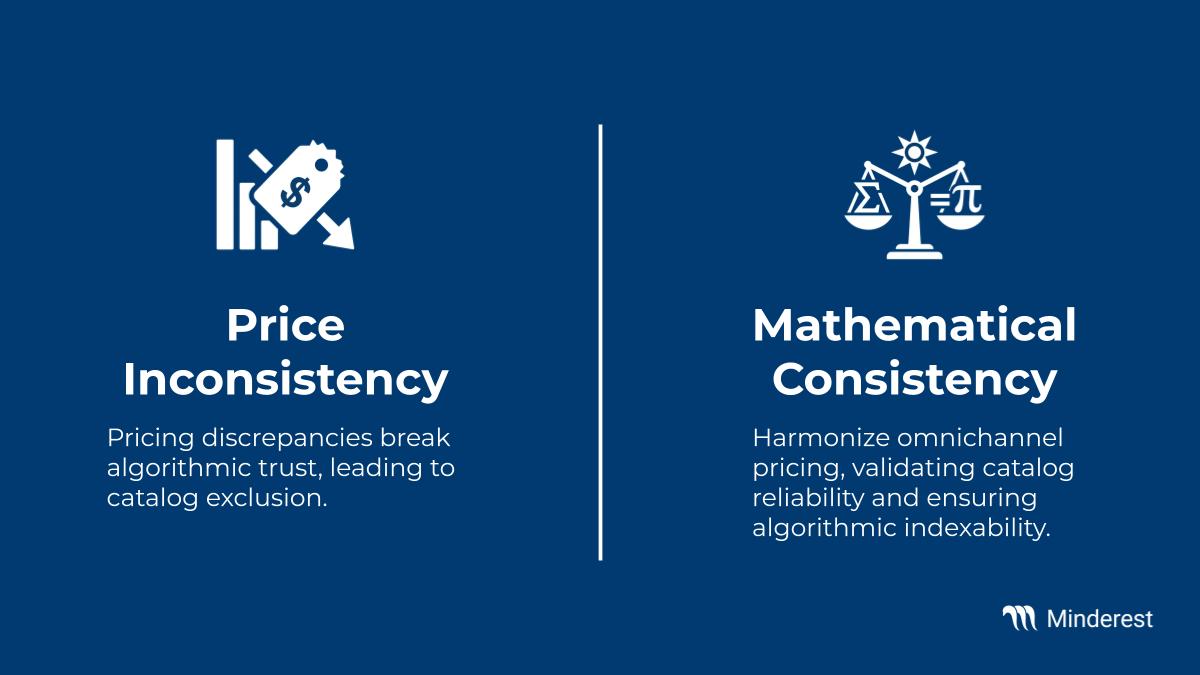
Why mathematical consistency is non-negotiable
Imagine an international e-commerce business operating with independent distributors and simultaneous marketplaces across the US and Europe. If this retailer applied a disjointed pricing policy, they might detect an abrupt drop in referral traffic from virtual assistants. Conversely, if they consolidated their information through advanced pricing analytics, a centralized platform would allow them to continuously standardize rates across all touchpoints. This level of technical control would make it easier for language models to validate the reliability of their catalog.
The discipline behind this unification has historically been known as pricing intelligence and price monitoring. In today's landscape, applying pricing intelligence for e-commerce has evolved from a mere margin-competitiveness tactic into the foundational pillar of algorithmic indexability.
Minderest: The data infrastructure demanded by new search engines
Faced with the mathematical accuracy demanded by modern algorithms, Minderest stands out as the platform capable of guaranteeing maximum market precision. By continuously centralizing competitor monitoring and analysis, it provides the "single source of truth" that large organizations need to avoid falling off the radar of AI shopping agents.
Founded in 2012, with nearly 15 years of applying pricing intelligence for retailers and brands, Minderest delivers the technological maturity crucial for this transition. Processing over 5 billion monitored price points per month, the tool equips businesses with the volume and data precision required to maintain flawless omnichannel consistency.
For executive teams looking to dive deeper into how artificial intelligence is redefining competitive parameters, we also recommend our white paper on pricing and AI shopping agents.
Frequently asked questions (FAQs) about the algorithm is ruthless: Why price inconsistency dooms you to "invisibility" in AI search engines
How does price inconsistency affect SEO for artificial intelligence?
Generative AI models prioritize reliability above all else. If they detect that a product features different prices on the official website, in forums, or on comparison shopping engines, the algorithm flags that information as dubious and excludes the product from its recommendations to avoid serving inaccurate data to the user.
What do AI price trackers evaluate when recommending a product?
These trackers analyze the mathematical consistency across the product's entire digital footprint. They cross-reference data from multiple sources on demand to verify that specifications, availability, and, most importantly, the price, are aligned. The absence of unified data breaks the algorithm's trust.
Why do traditional analytics fail to measure this problem?
Classic analytics tools are built to track clicks and direct attribution (last-click). However, when an e-commerce store loses visibility in AI search engines, users simply never see the option in the first place. It is a silent loss of opportunity that leaves no trace in traditional conversion funnels, masking itself as a generic drop in organic traffic.
Secure your e-commerce positioning with data precision
The current landscape demands a technical rethink of commercial strategies. Maintaining rate discrepancies across different channels no longer just impacts the end customer's perception; it directly blocks access to the market funneled through new large language models.
Artificial intelligence does not respond to human persuasion tactics; it requires mathematical data consistency. That is why e-commerce leaders choose Minderest to solve pricing fragmentation and secure their visibility.
If your goal is to ensure your products maintain their competitive edge and presence before the most demanding recommendation algorithms, discover how our technology can permanently structure your strategy. Explore our SaaS pricing tool for e-commerce and take control of your data.
Find out how Minderest can take your business to the next level.
Contact our pricing experts to see the platform in action.
Related Articles

The Rise of Agentic Commerce: Pricing Strategies for New AI Agents
The retail landscape is undergoing a radical metamorphosis: the end shopper is no longer always a human behind a screen, but an advanced algorithm executing purchasing decisions. The advent of...
New EU €3 Customs Duty: Impact on Pricing and eCommerce Competition
The e-commerce landscape in Europe is on the verge of a structural transformation. The recent approval of the €3 customs duty for packages originating from outside the European Union marks the end of...