
Maria Jose Guerrero
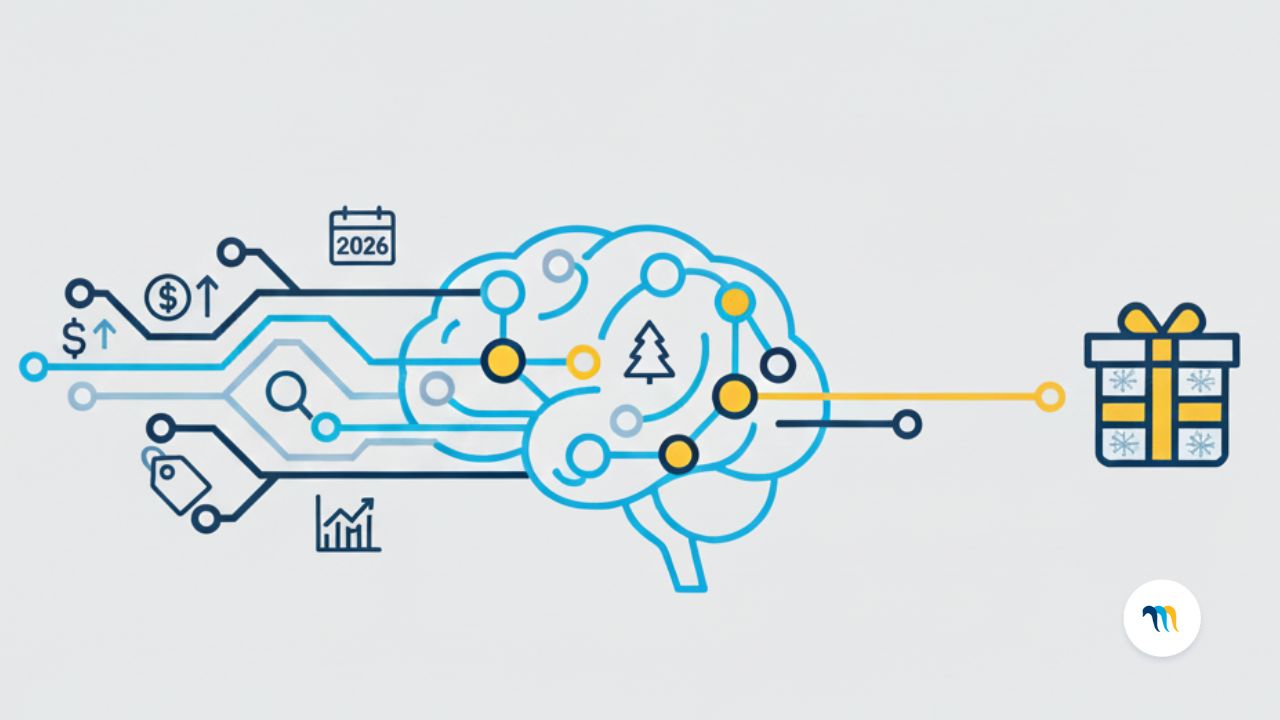
Holiday season planning used to revolve around creative campaigns, emotional storytelling, and optimizing the user experience. However, a silent revolution is changing the rules of the game. The rise of Google's AI agents and the new capabilities of ChatGPT have brought the algorithmic consumer to life: a shopper who delegates the final decision to a machine. The battle for Holiday Season 2026 sales won't be won in ads, but in the precision and competitiveness of your data.
Table of Contents
- The Silent Revolution: The Algorithmic Consumer Is Already Driving Sales
- The New AI Tools That Will Dominate the 2026 Season
- Is Your Pricing Strategy Ready to Be Judged by a Machine?
- Use Case: An Electronics Retailer Gets Ahead of the Algorithmic Christmas
- Checklist: Steps to Prepare Your E-commerce Business for 2026
- FAQs about Google Agents and ChatGPT for Holiday Shopping
- Act Now or Prepare to Be Invisible
"The battle for the holiday season is no longer won with ad creativity, but with data precision. AI doesn't negotiate; it simply chooses the best option."
— Antonio Tomás, CEO of Minderest
The Silent Revolution: The Algorithmic Consumer Is Already Driving Sales
The most profound shift in e-commerce over the last decade isn't a new sales channel, but a new type of buyer. A buyer who isn't swayed by branding or design, but operates with pure, data-driven logic.
From Search to Selection: The Paradigm Shift in Online Shopping
For years, the goal was to rank on the first page of Google. Now, the goal is to be the final choice of an AI agent that performs the search for the user. These assistants don't just find information; they compare, evaluate, and recommend the best purchase option based on objective criteria like price, stock availability, and the quality of product information. E-commerce has evolved from a game of visibility to one of algorithmic selection.
Why the 2026 Holiday Season Will Be the First Fully Algorithmic Battlefield
According to Salesforce, AI and digital agents are projected to drive around 21% of online orders during the 2025 holiday season, translating to approximately $263 billion in global sales. This will be the first peak sales season where a substantial portion of purchasing decisions will be fully automated. Companies that haven't adapted their peak season strategies to this new reality risk becoming invisible.
The New AI Tools That Will Dominate the 2026 Season
Two tech giants are leading this transformation with tools that are already active and redefining the shopping process. Understanding how they work is the first step to competing effectively.
Google's Agents (Gemini) and Automated Shopping
Google's new generation of artificial intelligence is integrated directly into its search and shopping ecosystem. These agents don't just answer questions; they can execute complex tasks like finding the best gift for a family member based on a few simple instructions.
To do this, they scan Google Shopping's vast inventory, comparing offers from thousands of retailers in real time. The accuracy of your data feed (price, stock, specifications, UPC/EAN) is no longer just an SEO best practice—it's a non-negotiable requirement for the algorithm to consider you a viable option. Furthermore, Amazon's recent return to Google Shopping intensifies the competition, making data and price optimization more critical than ever.
ChatGPT as Your New Personal Shopping Advisor
Meanwhile, OpenAI has launched the "Shopping Research" feature in ChatGPT. This tool allows users to ask the chatbot to research, compare, and summarize the best options for a specific product. A user might ask, "What's the best smartphone for under $500 with a good camera and long battery life?" ChatGPT will scan the web, read reviews, and compare prices to deliver a well-reasoned recommendation. For retailers, this means that their catalog's visibility no longer depends solely on their own website but on being a reliable and competitive data source for the AI that informs these decisions.
Is Your Pricing Strategy Ready to Be Judged by a Machine?
The arrival of the algorithmic consumer forces e-commerce managers to ask a fundamental question: can our pricing strategy win a competition based purely on data?
A static pricing strategy, reviewed manually once a week or even once a day, is an anachronism in the age of AI. A Google or ChatGPT agent performs its analysis in seconds. If your competitor adjusts their price just before that query, they've won the recommendation, and you weren't even in the race.
Why is dynamic pricing important for AI?
Dynamic pricing is crucial because AI agents, like Google's, evaluate and compare offers in real time. A static strategy makes you invisible to competitors who constantly adjust their prices. To be recommended by an algorithm, your offer must be competitive at the precise moment of the query.
Purchasing becomes purely rational: price and stock are the decisive factors. Therefore, the only way to compete is through automated competitor price monitoring and the ability to react with AI-driven dynamic pricing.
Adapt your pricing strategy to the age of AI. Discover how with our Price Intelligence solution.

Use Case: An Electronics Retailer Gets Ahead of the Algorithmic Christmas
Imagine an electronics retailer preparing for the 2026 holiday season. They know a significant portion of searches for "wireless headphones" will be influenced or conducted directly by AI agents.
- The Challenge: Currently, their prices are updated manually once a day, and their Google Shopping data feed sometimes has stock discrepancies. This makes them virtually invisible to AI recommendations, which dismiss their offers for not being the most competitive in real time or for having unreliable data.
- The Solution with a Price Intelligence Platform:
- They could use price monitoring software to track key competitors on Google Shopping and marketplaces several times a day.
- They would be able to set up dynamic repricing rules to adjust the prices of their headphones automatically, ensuring their offer always remains among the most competitive options the AI agent will evaluate.
- They could use catalog intelligence tools to ensure all their product attributes are correct and complete in their feed, optimizing it to be read by Google's algorithms.
- The Potential Outcome: The retailer would dramatically improve its visibility to algorithms. By consistently presenting a competitive and reliable offer, they would increase their chances of being the recommended choice, capturing a decisive market share in the growing volume of automated purchases and preparing to boost sales during key periods like Boxing Day.
Checklist: Steps to Prepare Your E-commerce Business for 2026
- Conduct a full audit of your data feed: Ensure that information for Google Shopping and other channels is 100% accurate, complete, and up-to-date (UPC, EAN, MPN, stock, attributes).
- Implement a dynamic pricing tool: Adopt a solution that allows you to react to market movements in minutes, not days.
- Monitor competitor stock availability: Identify opportunities when your rivals run out of stock on key products to capture that demand.
- Ensure the highest quality product information: Enrich your product pages with as much technical data as possible. AI values comprehensive information.
FAQs about Google Agents and ChatGPT for Holiday Shopping
What is an "algorithmic consumer"?
This is a type of shopper who uses artificial intelligence assistants (like Google agents or ChatGPT) to research, compare, and, in many cases, decide which product to buy. The final decision is based on objective data analyzed by the algorithm, such as price, availability, and features.
Do these AI agents only affect large marketplaces like Amazon?
No. AI agents, especially those from Google, analyze all available information on Google Shopping. Any retailer, large or small, with products on this platform can be evaluated and recommended if their offer is competitive and their data is accurate.
Is having the lowest price enough for an AI to recommend me?
Not necessarily. While price is a crucial factor, AI also evaluates other data points like stock availability, the quality and completeness of product information, and the seller's reliability. An offer with a slightly higher price but with perfect data and guaranteed stock might be preferred over the cheapest option if the latter has incomplete information.
How can I start preparing my e-commerce business today?
The first step is to audit the quality of your data feed and analyze your price competitiveness. Implementing a price and catalog intelligence tool will allow you to automate this process and make data-driven decisions.
Act Now or Prepare to Be Invisible
The era of AI-influenced shopping is not a futuristic prediction; it's the new operational reality for e-commerce. Ignoring this shift is not an option. While some companies continue to focus their resources on creative campaigns, their more agile competitors are optimizing their data to become the preferred choice of algorithms. Making your e-commerce business more competitive for the holidays no longer just involves a good marketing strategy, but an impeccable data strategy.
The 2026 season is already in full swing. The question is: will you be ready to sell to a machine?
Want to lead in the age of algorithmic commerce? Request a demo.
Find out how Minderest can take your business to the next level.
Contact our pricing experts to see the platform in action.
Related Articles

New EU €3 Customs Duty: Impact on Pricing and eCommerce Competition
The e-commerce landscape in Europe is on the verge of a structural transformation. The recent approval of the €3 customs duty for packages originating from outside the European Union marks the end of...
How Surveillance Pricing Works and Its Applications for Your Business
The term "Surveillance Pricing" might conjure images of corporate espionage and price manipulation. However, this initial perception hides one of the most sophisticated and powerful strategies in...